
OLGA'S PERSONAL APPROACH TO STORYTELLING
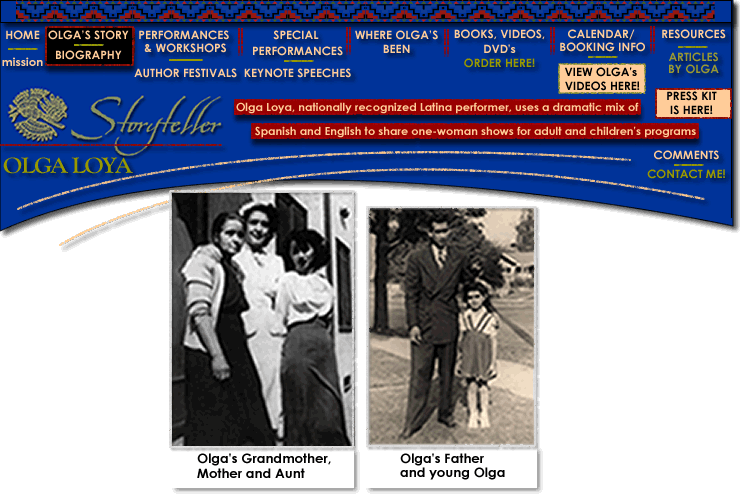
Long before I became a professional storyteller, I was a professional listener. I have always loved stories. My paternal grandmother, Grandma Loya, was a very good storyteller. She was a tiny, fragile woman with high cheekbones, deep–set eyes, and thick eyebrows. She pulled her hair back in a bun. She wore dark, long dresses with buttons in the front and shoes with little heels that tied in the front. I would go to see her as often as I could because I was madly in love with her and her stories. She would sit with me and tell stories about going to the mercado and visiting with friends. Sometimes she told me folktales—not very often but once in a while. Mostly, I liked to hear the stories about her life.
My father was also a very good storyteller. His stories always started out to be five minutes long but soon grew to be fifteen to thirty. He loved people—and people loved him in return. So I come by my storytelling naturally.
I grew up in East Los Angeles, California. I have always told stories and, in 1980, I went to my first storytelling conference. It was like a thunderbolt to my heart. I knew I wanted to be a storyteller. I knew I had to pursue the art of storytelling. At first I told stories from books from many different cultures, and then I discovered the stories from Latin America. A little at a time all the stories of my childhood started coming back to me and brought me back to the beauty of my family, my ancestors. They brought me back to the beauty of the place where I grew up—East Los Angeles. They brought me back to my culture, my roots. Stories are and were that powerful for me. Soon I started remembering my family stories, and that just added another dimension to my evolution as a storyteller. Now I am doing theater pieces, which may embody an entire theme. Some of the pieces like “Dancing Through La Vida” are done with music. Others are done with an installation, like the “Day of the Dead” shows, which have an altar as part of the performance. Another new dimension is doing a chautauqua piece on Juana Briones, a 19th-century California woman. I do her in costume and in her own voice.
In my performances, the audience is able to see different styles of telling because I perform personal tales, folklore, and do improvisation, where I enjoy involving the audience in a number of surprising ways.
Stories are told everywhere in the world. There is a definite resurgence of storytelling. As a result, storytellers have opportunities to do many different types of work. Over the course of a month I worked in a Hispanic festival, I presented a theater piece at the University of Michigan, I am storytelling at a museum, I am telling stories in a junior high and elementary school, and am also telling stories to teenagers at a vision quest.
I have always wanted to do something with a passion and now it's come true!
WHAT PEOPLE ARE SAYING!
“I like to tell stories because they have a way of entertaining, teaching and giving people strength.
Through stories, people see how other people live, how they think and they could live.
Stories are good for the mind and heart.”
Olga Loya
“A great storyteller, such as you, empowers children and adults to use their imagination.”
Jim Johnson, Dean, Arts, Humanities & Communications Division, Modest Junior College
“Olga Loya is a masterful storyteller, who has been dedicated to developing her art over the arc of a long and illustrious career outside the purview of our Anglo-dominant storytelling community. Her maturity is revealed by the uniqueness of her style, the depth and breadth of her material, and her singular point of view. In Hawaii they say older women are the best dancers, because of all they know and can communicate with every fiber of their bodies and souls. That is how I think of Olga.”
Storyteller, Carol Birch
